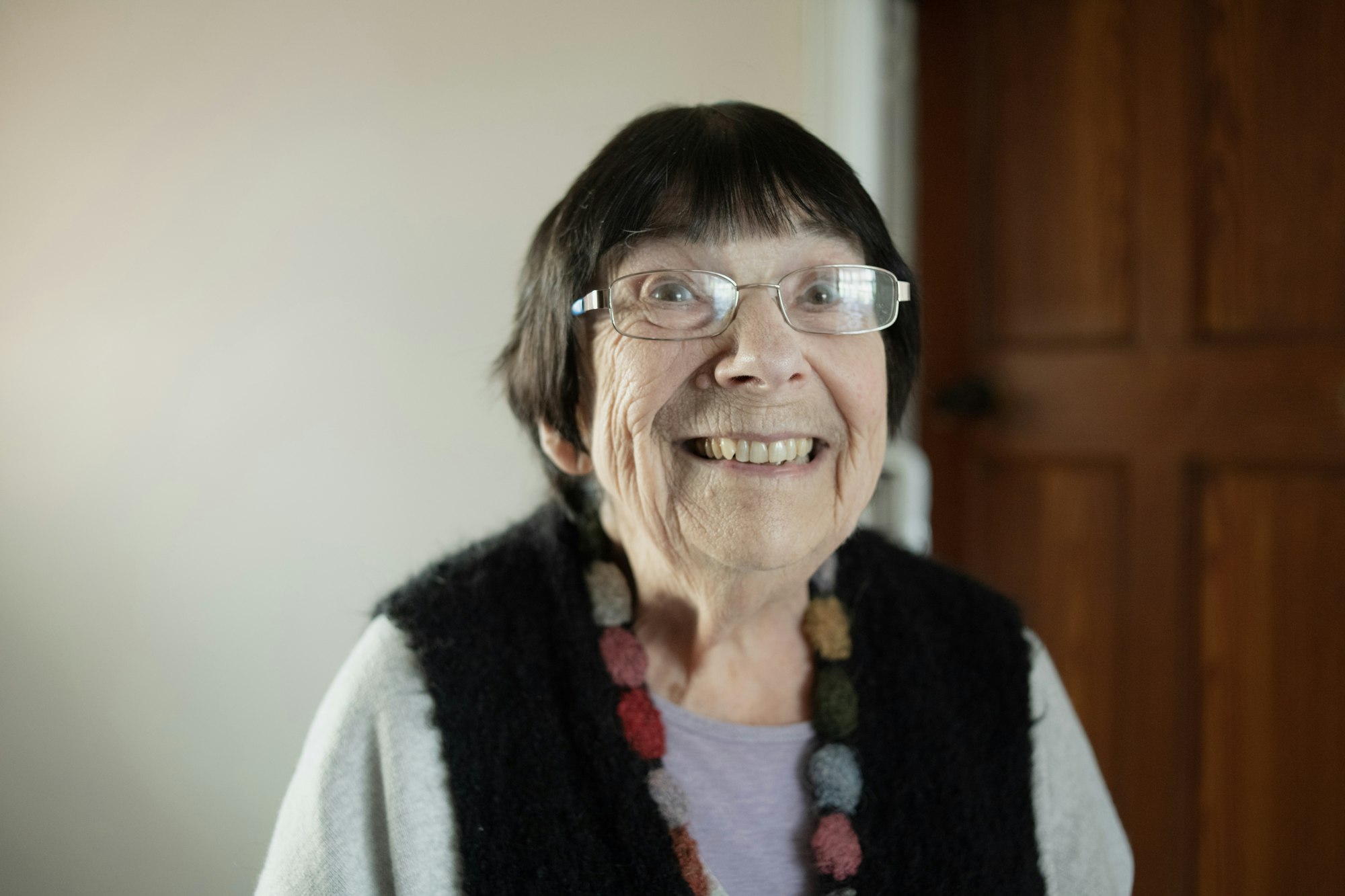
For memory care
You can't remind them when they can't remember.
But you can be there.
Residents with dementia fall at 2.5 times the rate. We're studying an investigational in-home assistive robot that stays present for the moments cognition takes away.
62%
2.5×
of residents with dementia fell within six months — 2.5 times the rate of residents without.
Prospective study, residential care facilities — Archives of Gerontology and Geriatrics, 2008
Same buildings, same staff, two and a half times the falls. The difference isn't strength or balance alone. It's cognition in the moment.
The judgment that prevents a fall is exactly what dementia takes.
- Forgets the walker
- Stands impulsively
- Wanders at night
- Misjudges obstacles
- Forgets physical limitations
- Becomes agitated or restless
Six in ten people living with dementia will wander at least once — many do so repeatedly.

You can post the reminder in every room. It won't be there in the moment.
A reminder assumes the moment of decision remembers the morning's conversation. In memory care that assumption fails completely — the distance between the reminder and the moment is what the disease erases. The only thing that works is presence at the point of decision: something in the room, at the moment of rising, making the safe way the easy way.
The design-partner study
A research study, shaped by your building.
We're assembling a small group of memory-care units as design partners in a research study, designed with a university research partner for the National Institute on Aging's small-business research program. Design partners shape what the robot becomes — what it does on your floors, how it alerts your staff, what a night's report looks like — and what changes is measured against your own fall logs.
Mobility metrics
The numbers a clinic visit can't catch.
A mobility assessment in a clinic is a snapshot — one walk, on a good day, under observation. In the study, the robot measures the real thing every day: the time from bed to the bedroom door, the round-trip time of a 2am bathroom trip, walking speed along the usual routes. The segments are configurable, and the trends build quietly in the background.
Bed to door
Time from rising to reaching the bedroom door.
Bathroom round trip
Door to door on the 2am trip — the one nobody else sees.
Time to answer the door
From the knock to the open door.
Walking speed
Pace along usual routes, measured passively — no test, no stopwatch.
Sit to stand
How long rising takes, and how it trends.
The robot measures; your clinical team interprets. A slowing week might mean a physical-therapy referral or a medication review; a sustained one gives your team the trend to know — and justify — when it's time for a higher level of care. That judgment stays with your team, with objective numbers under it. Your wellness team sets the segments and the thresholds that matter in your building.
Shared only with the resident's consent.
Why these numbers matter: in pooled cohort data, gait speed alone predicted survival in older adults as accurately as combined measures of age, sex, mobility aids, and self-reported function. Studenski et al., JAMA 2011
Apply to be a design partner.
The question every memory-care director asks — how do residents with dementia respond to a robot? — is exactly what the study is designed to answer. We'd rather explore it with you than guess.
A 30-minute call with a founder — your fall numbers, the study design, and whether your unit fits.